
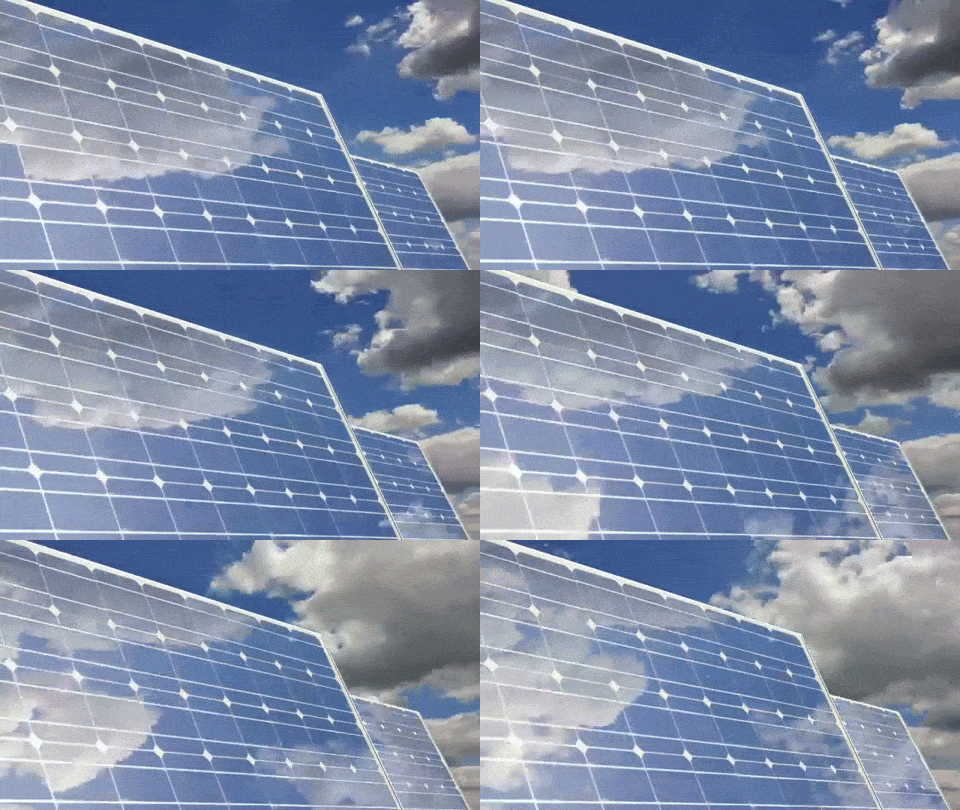
5000 MW Ultra-Mega Solar Power Project. Powering Dholera's ambition to be a net-zero sustainable smart city.
The Dholera Solar Park is not just a collection of panels; it is a High-Performance Energy Refinery. Utilizing the latest in Bifacial N-Type Monocrystalline modules, the park achieves unprecedented efficiency by capturing light from both the sun and the reflected "Albedo" of the arid ground.
By optimizing the tilt and height of the trackers based on real-time solar positioning, our AI orchestration layer ensures that every square centimeter of silicon is operating at its maximum thermodynamic potential. This is Active Photon Capture, where every ray of light is converted into economic value for the region.
The greatest challenge of massive-scale solar is grid stability. Dholera addresses this through an integrated BESS (Battery Energy Storage System) that provides near-instantaneous Frequency Regulation. By buffering the "Intermittency" of solar generation, the park ensures that the quality of power delivered to the Dholera SIR’s industrial users is of a "Mission-Critical" standard.
Our AI management system, Aura Grid, predicts cloud cover and solar intensity using satellite telemetry, allowing the system to adjust the storage-discharge cycles proactively. This reduces "Ramp-Down" stress on the national grid and positions Dholera as a primary node in India's One Sun, One World, One Grid (OSOWOG) initiative.
Surplus energy generated during peak hours is diverted to Electrolyzer Units to produce high-purity Green Hydrogen. This hydrogen acts as a long-duration energy storage medium and a clean fuel source for the Dholera industrial ecosystem, effectively creating a Zero-Waste Energy Cycle.
Water is a precious resource in Gujarat. To maintain peak efficiency without water consumption, the Dholera Solar Park utilizes Waterless Dry-Cleaning Robots. These autonomous units traverse the arrays daily, removing dust and particulates and preventing "Soiling Losses," which can reduce output by up to 25% in arid environments.
These robots are monitored by our Digital Twin environment, which tracks the "Cleaning Velocity" and ensures that no module is left unattended. By eliminating the need for manual scrubbing and water logistics, we reduce the operational "OPEX" of the park by 30% while increasing the healthy lifespan of the modules.
The efficiency of the Dholera Solar Park begins at the atomic level. By selecting N-Type TOPCon (Tunnel Oxide Passivated Contact) cells, we mitigate the effects of Light-Induced Degradation (LID), ensuring that the park’s output remains stable for over 30 years. These cells utilize a thin tunneling oxide layer to minimize electron recombination, pushing the theoretical efficiency limits of silicon.
Furthermore, our modules are optimized for High-Temperature Performance. In the arid heat of Dholera, standard panels suffer from a significant "Temperature Coefficient" loss. Our selected components feature a low-temperature coefficient, ensuring that energy harvesting continues even when ambient temperatures exceed 45°C. This is not just solar; it is Extreme-Environment Engineering.
We also track the Spectral Response of the park. Dholera’s unique atmospheric profile allows for significant harvesting in the near-infrared spectrum during the early and late hours of the day. By adjusting the "Gate Voltage" of our central inverters, we maximize the conversion of these low-energy photons, effectively lengthening the "Solar Day" by up to 45 minutes.
Multi-Technology Energy Buffering
Dholera’s storage strategy is multi-modal. For short-duration, high-power bursts (frequency regulation), we utilize Lithium-Iron-Phosphate (LFP) battery arrays. These systems can inject or absorb hundreds of megawatts in milliseconds, stabilizing the grid against "Flicker" and voltage sags.
For long-duration storage and seasonal "Energy Shifting," we are piloting Vanadium Redox Flow Batteries (VRFB). Unlike lithium, flow batteries do not degrade over thousands of cycles and can store energy for days. This hybrid approach ensures that the Dholera SIR has a Sovereign Power Reserve, immune to the volatility of external energy markets.
Finally, the "Peak Surplus" is handled by our Green Hydrogen electrolyzers. This hydrogen is stored as a high-density gas and can be reconverted to electricity via fuel cells during the rare periods of low solar irradiation, ensuring absolute reliability for the city’s data centers and hospitals.
Traditional power plants provide "Inertia" through their spinning turbines, which keeps the grid frequency stable. Modern solar parks often lack this. Dholera solves this with Grid-Forming Inverters that provide Synthetic Inertia. Our inverters "mimic" the behavior of heavy machinery, providing a stabilizing force that prevents grid collapses.
This advanced power electronics suite also provides Reactive Power Support and voltage control. By acting as a "Static Var Compensator" (SVC), the park actively cleans the power on the regional grid, reducing "Harmonic Distortion" for the sensitive electronics in Dholera’s semiconductor fabs. We don't just produce power; we Refine It.
Sustainability is as much about people as it is about photons. The Dholera Solar Park is a catalyst for Human Capital Development. We have established a Renewable Energy Academy on-site, training local youth in advanced robotics, solar maintenance, and grid management. This ensures that the high-tech jobs created by the park remain within the regional community.
Furthermore, we utilize Agrivoltaics in designated zones—growing shade-tolerant crops beneath the solar arrays. This dual-use land strategy provides a secondary income for local farmers and reduces the "Heat Island" effect around the panels, further boosting their efficiency. This is a Symbiotic Economy, where technology and tradition thrive together.
The operational brain of the Dholera Solar Park is the Aura-S SCADA (Supervisory Control and Data Acquisition) system. This IoT-integrated platform monitors over 2.5 million data points every second, from individual string currents to the ambient humidity levels at the sub-station. By utilizing edge-computing nodes, we process this data locally to minimize latency in our "Safety-Critical" response loops.
Aura-S features Predictive Fault Detection. By analyzing subtle variations in voltage signatures, the system can predict an inverter failure or a cable degradation weeks before it occurs. This proactive maintenance model ensures that the park’s availability remains above 99.5%, even during the peak summer months.
The system is also integrated with the National Load Despatch Centre (NLDC), allowing for seamless participation in the energy "Ancillary Services" market. Dholera is not just a participant in the grid; it is a primary architect of its stability.
Energy generated at the 11,000-hectare park is evacuated via a state-of-the-art 400kV/220kV Pooling Substation. This facility utilizes Gas-Insulated Switchgear (GIS) to minimize the physical footprint and increase reliability in the saline environment of coastal Dholera. The substation is connected to the national grid via redundant high-voltage transmission lines.
Each block of the park is equipped with its own modular 220kV step-up transformer, ensuring that a fault in one section does not impact the entire park’s generation. This modularity is key to our "Zero-Downtime" philosophy. We have also incorporated STATCOM (Static Synchronous Compensator) units at the pooling point to ensure that the power factor remains near unity, providing a clean, stable energy stream to the Dholera Special Investment Region.
Prosperity through Green Energy
The Dholera Solar Park is committed to the local ecology of the Gulf of Khambhat. We have successfully implemented a Mangrove Restoration Program flanking the park boundaries, which serves as a natural carbon sink and a buffer against tidal surges. This program is part of our broader ESG 2050 Framework.
In the neighboring villages, we have launched the Grameen-Solar Initiative, providing off-grid solar kits and clean water filtration systems to over 5,000 households. By ensuring that the benefits of the "High-Tech SIR" trickle down to the local grassroots, we are building a foundation of shared prosperity and long-term social stability.
The Aura Grid orchestration layer utilizes a Recurrent Neural Network (RNN) architecture to forecast solar variability. By training on over five years of localized meteorological data and high-frequency inverter logs, the model can predict a "Cloud Transient" (shading event) 45 seconds before it reaches the park. This allows the BESS (Battery Energy Storage System) to begin ramp-up operations in advance, masking the drop in PV output from the grid.
Furthermore, we utilize Computer Vision at the array level. High-resolution cameras mounted on the trackers analyze the "Specular Reflection" from the modules to identify micro-cracks or "Hot Spots" that are invisible to the naked eye. By identifying these issues at the sub-atomic level, we can isolate individual strings before they impact the overall DC-bus voltage, maintaining the highest possible Performance Ratio (PR) for the entire 5GW estate.
The Dholera Solar Park is not just a utility; it is a Civilizational Asset. By masterfully blending advanced PV physics, massive-scale storage, and AI-driven grid management, we are providing the "Clean Oxygen" that will fuel India's industrial miracle for the next century.
Join the green revolution. Dholera offers incentives for sustainable industries and renewable energy partners.

The Collection
Unlock detailed floor plans, pricing sheets, and ROI analysis for Dholera SIR and Greater Noida West.