
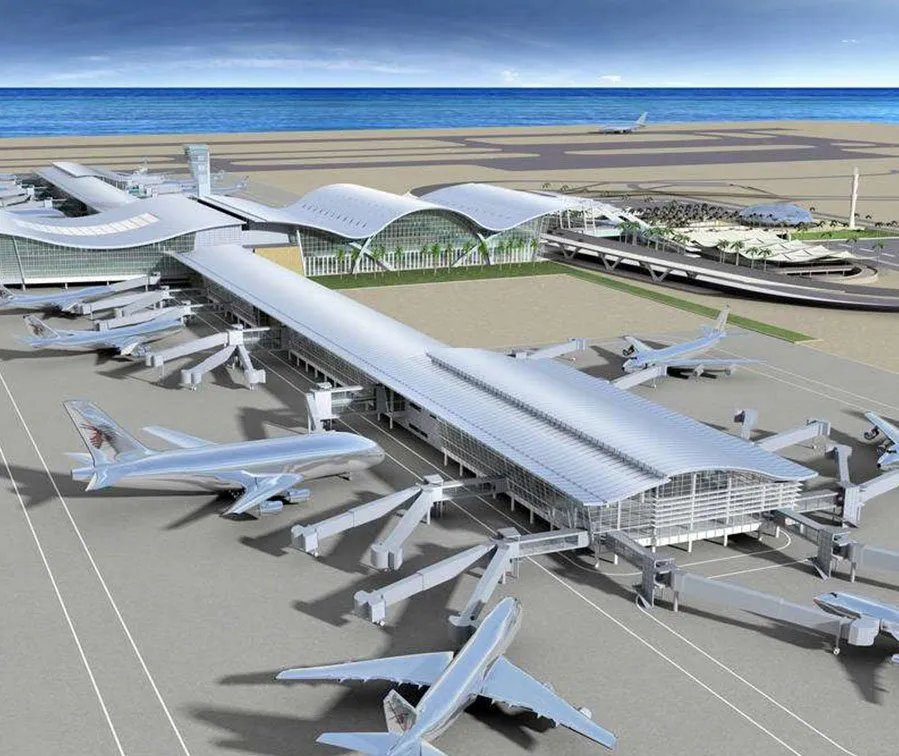
Dholera International Airport (federa). A world-class greenfield airport designed to handle 100 Million passengers and massive cargo operations.
The Dholera International Airport (DIACL) is a cornerstone of the DMIC (Delhi-Mumbai Industrial Corridor). Spanning 1,426 hectares of prime logistical real estate, it represents the most significant greenfield aviation project in Western India.
Designed as a dual-purpose facility, it bridges the gap between massive passenger demand and the intensive cargo requirements of the Dholera SIR. With its 4,000m runway, it is one of the few airports in the region capable of handling the heaviest long-haul freighter aircraft fully loaded.
Al-driven cargo sorting and autonomous ground handling for sub-millisecond precision.
Engineered with Zone-3+ structural reinforcements for absolute operational continuity.
Unlike standard airports that rely heavily on passenger traffic, Dholera follows a Cargo-Led Development Model. This strategy capitalizes on its location within the DSIR (Dholera Special Investment Region), where heavy manufacturing, semiconductor fabs, and aerospace units require rapid, reliable export channels.
By providing dedicated freight corridors and a Customs-Bonded Logistics Park within the airport perimeter, we reduce the "Dwell Time" of export goods by over 60%. This efficiency translates directly into lower capital costs for manufacturers and a more resilient supply chain for global distributors.
With the Tata Electronics semiconductor fab scheduled for production in 2026, the Dholera Airport is prioritizing the activation of the High-Value Material Airway—a specialized terminal with climate-controlled handling specifically for silicon wafers and sensitive optical components.
Final certification and licensing are underway. The airport is positioned to become the primary logistical engine of North-Western India by Q2 2026.
The Dholera Aerocity is a 75-hectare commercial powerhouse flanking the passenger terminal. It is designed to host the regional headquarters of multinational logistics firms, high-end hospitality brands, and 24/7 convention centers.
Tier-1 office spaces with direct airside access for corporate aviation, enabling global executives to transit from flight to boardroom in minutes.
Luxury hospitality integrated with the Aura OS, providing biometrically secured transit rooms for international cargo crews and travelers.
Dedicated R&D zones for aviation engineering, drone testing, and last-mile autonomous delivery pilot programs.
| Key Metric | 2026 Projections | 2030 Projections | Strategic Outcome |
|---|---|---|---|
| Cargo Thruput | 0.5M Tons | 2.0M Tons | Logistical Dominance in West India |
| Passenger Volume | 3M PA | 12M PA | Primary Gateway for South Gujarat |
| Job Creation | 15,000+ | 50,000+ | Regional Socio-Economic Lift |
| Carbon Footprint | Net-Neutral (Ops) | Negative (Solar Offset) | Global Sustainablity Leadership |
The Dholera region, while ideal for aviation due to its flat terrain, requires sophisticated Meteorological Management to ensure 24/7/365 operations. The airport is equipped with an advanced AWOS (Automated Weather Observing System) that provides real-time data on RVR (Runway Visual Range), wind shear, and atmospheric pressure to both the ATC and incoming aircraft.
By utilizing CAT III-B Instrument Landing Systems (ILS), Dholera can maintain operations even in conditions of near-zero visibility. This is a critical requirement for international cargo freighters that operate on tight, global schedules. We have eliminated the "Weather Delay" variable from the logistical equation. This is Operational Certainty.
Furthermore, the airport features a stabilized approach path with high-intensity PAPI (Precision Approach Path Indicators) and a redundant power supply for all navigational aids. In the event of a regional grid failure, the airport’s dedicated solar-backed micro-grid activates in less than 50 milliseconds, ensuring that critical safety systems never blink.
Next-Gen Air Traffic Control Infrastructure
Dholera features one of India's first Digital Air Traffic Control Towers. Utilizing high-definition 360-degree cameras and augmented reality overlays, our controllers have a "Super-Human" view of the airfield, even during monsoon events or heavy dust storms. The system automatically identifies aircraft, ground vehicles, and even wildlife, highlighting potential conflicts in real-time.
This technology allows for a much higher "Tempo of Operations" (movements per hour) while significantly reducing the risk of human error. By integrating with the regional Airspace Management System, Dholera acts as a secondary "Safety Valve" for the congested air corridors of Mumbai and Ahmedabad, providing a reliable alternative for diversions and emergency landings.
The tower is linked via a dedicated fiber-optic ring to the Global Aviation Network, ensuring seamless hand-offs for transcontinental flights. We are not just managing an airport; we are choreographing a Global Ballet of Cargo and Capital.
The Dholera terrain, characterized by its clay-rich soil, presented a unique Geotechnical Challenge. Our engineers implemented a massive Soil Stabilization Program, utilizing deep-pile foundations and vacuum consolidation to ensure that the 4,000m runway remains perfectly level under the immense weight of a fully loaded An-124 or A380-800.
The runway surface itself is a masterclass in Polymer-Modified Bitumen (PMB) technology. This material is designed to resist "Rutting" and thermal cracking in the high-temperature environment of Gujarat. By utilizing a "Friction-Course" layer, we ensure maximum braking efficiency for aircraft, even under heavy rain conditions. This is Safety-First Engineering.
| Layer | Thickness | Material |
|---|---|---|
| Wearing Course | 50mm | PMB Friction Course |
| Binder Course | 100mm | Dense Bituminous Macadam |
| Base Course | 250mm | Wet Mix Macadam |
| Sub-Base | 450mm | Granular Sub-Base |
| Sub-Grade | 1000mm | Stabilized Compensatory Soil |
Efficiency at the terminal is mirrored at the wing-tip. Dholera’s apron features a High-Pressure Hydrant Fueling System. This eliminates the need for fleets of fuel trucks, reducing congestion on the ramp and significantly lessening the risk of tarmac incidents. Fuel is pumped directly from a secure, underground Fuel Farm through a redundant loop system.
By providing rapid refueling for heavy-haul freighters, we reduce "Ground Time" and increase the overall utility of the aircraft. For a global logistics provider, every minute saved on the ground in Dholera is a minute of revenue in the air. We are also preparing for the future by incorporating SAF (Sustainable Aviation Fuel) storage and blending facilities, allowing Pranth-affiliated projects to lead India's transition to green aviation.
The Dholera International Airport adheres to the highest global safety standards, categorized as an ICAO Category 10 facility for fire and rescue services. Our ARFF (Aircraft Rescue and Firefighting) station is equipped with high-performance rapid-intervention vehicles capable of reaching any point on the 4,000m runway in under 120 seconds.
Security is equally prioritized through a Multi-Layered Shield. Utilizing AI-enhanced perimeter intrusion detection systems (PIDS) and biometric access control for all airside personnel, we ensure that the critical assets of our industrial partners are protected 24/7. This security framework is integrated with the Pranth Aura OS, allowing for centralized monitoring and rapid response orchestration.
The security protocol extends to the digital realm. The airport's Cyber-Defense Center monitors all navigational and logistical data streams for anomalies, ensuring that the "Digital Twin" of the airport remains secure from external interference. This commitment to both physical and digital safety is why Dholera is the preferred gateway for high-value industries.
Flanking the main taxiways is a dedicated 250-hectare Special Aviation Zone. This zone is tailored for MRO (Maintenance, Repair, and Overhaul) facilities, aircraft assembly plants, and pilot training academies. By providing tax incentives and direct "Airside Access" for manufacturing units, Dholera is fostering a complete aviation ecosystem.
This SAZ is designed to accommodate the growing needs of India's commercial fleet, which is expected to double by 2030. Manufacturers can fly in components, assemble aircraft, and perform test flights all within a single, customs-bonded perimeter. This integration of Aerospace Manufacturing and Logistics is the hallmark of a world-class Aerotropolis.
The airport is not an isolated island. It is seamlessly integrated with the Ahmedabad-Dholera High-Speed Rail and the massive 6-Lane Expressway. This ensures that cargo arriving at the tarmac can be at a distribution center in Ahmedabad or a factory in the SIR within 45 minutes.
For passengers, the HSR Link provides a "City-to-Gate" experience that rivals the best airports in Singapore or Dubai. The integrated terminal station allows travelers to check their bags at the city center and proceed directly to security upon arrival at the airport. This is Frictionless Mobility.
The underground storage tanks of the Dholera Fuel Farm are a feat of Geochemical Engineering. Given the saline nature of the coastal groundwater, our tanks utilize a Double-Wall Glass-Fiber Reinforced Plastic (GRP) cladding with an integrated vacuum-interstitial monitoring system. This prevents any possibility of fuel leaching into the sub-grade while protecting the steel core from corrosive chloride ions.
The fuel delivery system also incorporates Digital Quality Sensors that monitor the flash point, density, and particulate count of the Jet-A1 fuel in real-time as it passes from the storage farm to the hydrant loops. This ensures that every aircraft refueling at Dholera receives fuel of a "Laboratory-Grade" purity, significantly extending engine life for our airline partners.
Dholera International Airport is not just a gateway; it is the Logistical Heart of a new India. From its seismic-reinforced runways to its AI-driven ATC tower, every detail is engineered to support the rapid movement of goods, people, and ideas across the global landscape.

The Collection
Unlock detailed floor plans, pricing sheets, and ROI analysis for Dholera SIR and Greater Noida West.