
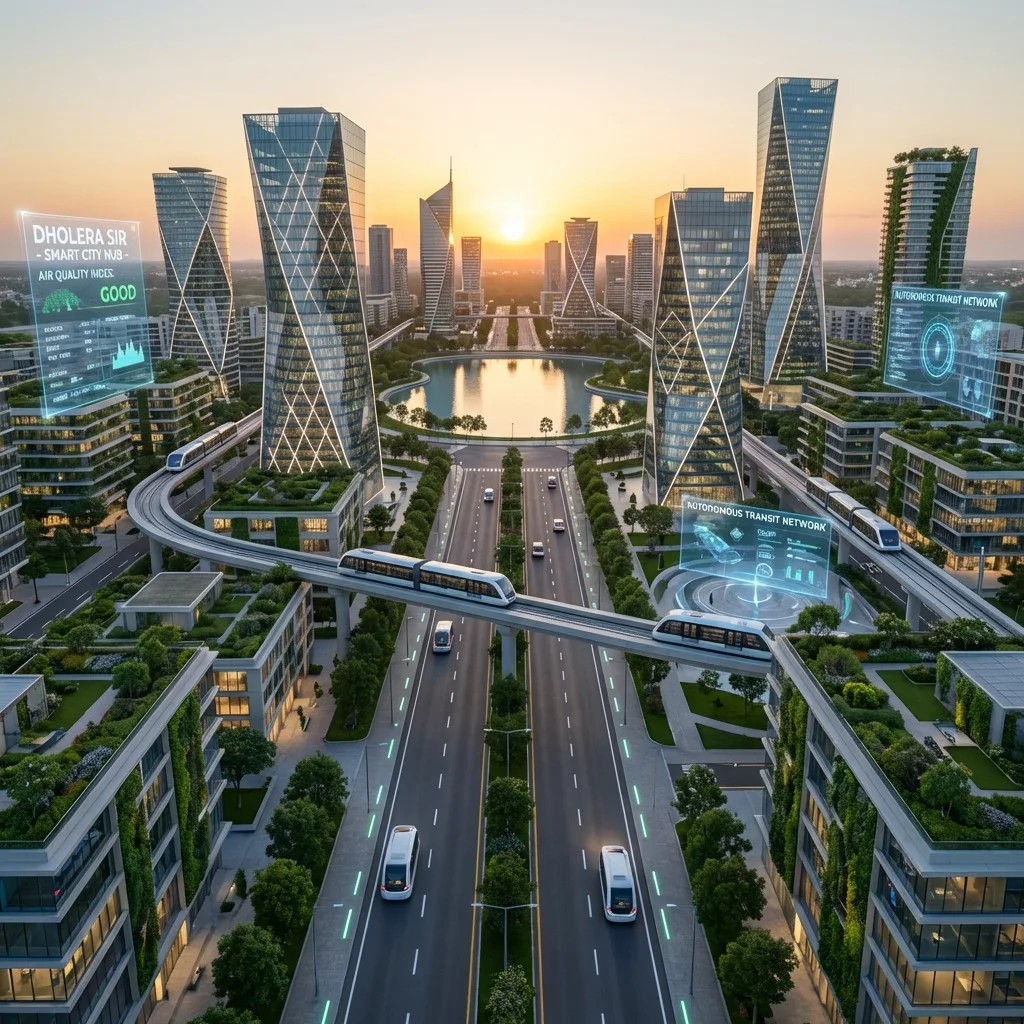
As we stand at the threshold of 2026, the Dholera Special Investment Region (SIR) has evolved from a grand vision into India’s most significant industrial and technological landmark. The transformation of this 920-sq-km region into a global manufacturing hub is no longer a matter of "if" but "when," with 2026 serving as the definitive turning point in India‘s journey toward a $5 trillion economy.
The Macro Vision: A Greenfield Revolution on a Global Scale
Dholera SIR is not merely a town or an industrial zone; it is a meticulously planned Greenfield Smart City, the first of its kind in India. Spanning over 920 square kilometers, it is larger than the city of Singapore. The vision, backed by the Delhi-Mumbai Industrial Corridor (DMIC) and the Government of Gujarat, was to create a "Plug-and-Play" environment that could compete with the world‘s most advanced industrial hubs like Shenzhen or Jurong. By 2026, the foundational infrastructure required to support this scale is not just ready—it is flourishing. We are creating a New Urban Paradigm where life and industry coexist in a symbiotic loop.
The urban planning of Dholera is rooted in the concept of Integrated Townships. Unlike existing cities that grow organically and often chaotically, Dholera follows a modular development plan. The master plan ensures that residential, commercial, and industrial zones are harmoniously separated yet efficiently connected. This scientific approach to urbanism eliminates "urban sprawl" and provides a template for the future of Indian urbanization. Each module is designed to be self-sufficient, featuring its own green lungs and utility centers.
Global Benchmarking: Dholera vs. The World
To appreciate the scale of Dholera, one must look at global precedents. The project is often compared to Shenzhen in China or Songdo in South Korea. However, Dholera has a unique advantage: it is being built with "Sustainability 2.0" at its core. While Shenzhen grew as a labor-intensive manufacturing hub, Dholera is designed as a technology-intensive, Net-Zero hub. The city‘s utility infrastructure is entirely underground, featuring "Walkable Tunnels" that house fiber optics, power, and water lines, ensuring that the city surface remains aesthetically pure and maintenance-free. This reduces "Surface Friction" and allows for a pedstrian-first urban experience that is unique in Asia.
This allows Dholera to offer an Ease of Doing Business score that rivals Singapore. For a global manufacturer, the "Time to Market" is reduced by 40% because the infrastructure—from power ratings to logistics links—is pre-certified and ready for immediate deployment. The Dholera Single Window Portal is a benchmark in digital governance, providing all approvals within a defined 30-day window.
The Semiconductor Revolution: India’s Strategic Pivot
The centerpiece of Dholera’s rise is undoubtedly the Tata Electronics Semiconductor Fab. In partnership with Taiwan’s PSMC, this ₹91,000 crore investment is the single most critical project for India‘s technical sovereignty. As of 2026, the clean-room environments are being calibrated to produce 50,000 wafers per month, focusing on 28nm and 40nm nodes that power everything from cars to 5G infrastructure. This is not just a factory; it is the Nucleus of an Ecosystem.
This presence has triggered a massive supply-chain migration. Over 40 specialized vendor companies, ranging from high-purity chemical suppliers like Linde to precision component manufacturers, have already taken up land in the Dholera SIR. This creates a "Cluster Economy" that reduces logistics costs and increases innovation throughput. The semiconductor fab acts as a "Gravity Well," attracting talent and capital from across the globe. We expect the semiconductor cluster alone to contribute over $12 billion to the regional GDP by 2030.

Trunk Infrastructure: The 2026 Powerhouse
What sets Dholera apart is the concept of Trunk Infrastructure. In most cities, roads and power follow demand. In Dholera, they precede it. The 22.5 sq. km Activation Area is 100% operational, featuring underground utility tunnels that prevent any need to dig up roads for maintenance. This is the hallmark of a world-class smart city. Every street is equipped with Smart Poles that integrate 5G small cells, EV chargers, and environmental sensors.
The ABCD Hub: The Digital Brain
The Administrative and Business Centre for Dholera (ABCD) building houses the city‘s Command and Control Center (CCC). This center monitors every aspect of city life—from traffic flow to water consumption—in real-time. By 2026, it is fully integrated with the national logistics portal, making Dholera the most efficient industrial node in Southeast Asia. The CCC uses AI algorithms to predict traffic congestion and optimize energy distribution, potentially saving millions in operational costs for the city. It is the "Digital Heartbeat" that ensures the SIR never sleeps.
Smart Governance: The Dholera Model
Dholera is not just a triumph of engineering; it is a triumph of Governance. The city operates under a single-window clearance system that is digitized end-to-end. This eliminates the bureaucratic friction often associated with large-scale projects. The "Dholera Special Investment Region Act" provides a robust legal framework that ensures policy consistency, which is the number one requirement for international institutional investors. The SIR is managed by a dedicated Special Purpose Vehicle (SPV), ensuring professional management and rapid decision-making.
Furthermore, the city utilizes "Dynamic Zoning." Unlike static plans, Dholera‘s land-use patterns can be adjusted based on the evolving needs of the industrial clusters, ensuring that the city remains efficient as technology changes. This flexibility is what makes Dholera a "Living City" rather than a static monument. We are planning for Generational Adaptability.
Industrial Clusters: A Divergent Economy
While semiconductors are the headline, Dholera is a multi-sector powerhouse:
- Aviation & Defense: Leveraging the new airport for MRO (Maintenance, Repair, Overhaul) services. This cluster is expected to attract over $2 billion in investment.
- Electric Vehicles (EV): Companies like Tata AutoComp are setting up lithium-ion battery assembly plants here, creating a complete EV value chain.
- Renewable Energy: Powered by the 5GW Solar Park, providing the lowest industrial power tariffs in the region. This is a massive competitive advantage for power-hungry industries.
- Advanced Materials: Specialized zones for carbon-fiber and composite manufacturing, supporting the aerospace and automotive sectors.
- Biotech & Pharma: Leveraging the high-purity water and stable power for advanced pharmaceutical manufacturing.
The Logistics of Liquids: Water Management in the SIR
In the arid landscape of Gujarat, water is the ultimate resource. Dholera‘s water management is a closed-loop marvel. We utilize Smart Water Grids that monitor pressure and detect leaks in real-time. But the real innovation is the Recycled Water Network. Every drop of industrial and domestic wastewater is treated to tertiary standards and reused for landscaping and industrial cooling. This ensures that the city remains lush and productive without depleting the local water table—a critical factor for long-term sustainability and industrial reliability. We have engineered a Zero-Liquid Discharge (ZLD) policy for the entire industrial zone.
Seismic Engineering: Building for 100 Years
Dholera is built to last. Given the regional geology, the entire city‘s foundation is engineered for high seismic resilience. Trunk infrastructure is built on specialized "floating foundations" that can withstand significant ground movement without catastrophic failure. At Pranth, we adopt these same industrial standards for our residential projects. From base isolation techniques to high-tensile steel reinforcement, we build for a 100-year lifecycle. This is the "Security of the Structure" that underpins every Pranth investment. We conduct Ground-Structure Interaction (GSI) analysis for every major development.
Connectivity: The Ribbon that Ties it All Together
Connectivity is the lifeblood of Dholera. By 2026, the "Golden Triangle" is established:
- Expressway: Ahmedabad to Dholera in under 55 minutes via a smart, sensor-enabled highway. This is India‘s first "Access-Controlled" smart expressway.
- High-Speed Rail: Connecting to the Mumbai-Ahmedabad HSR corridor, bringing Mumbai within a 3-hour reach and facilitating the "Reverse Brain Drain."
- Dedicated Freight Corridor (DFC): Allowing goods to reach the ports of JNPT or Mundra with unrivaled efficiency, reducing logistics costs by up to 25%.
Social Infrastructure: Building a Liveable Future
A city is more than its factories. Dholera is designed with a "Human-Centric" focus. The master plan includes world-class hospitals, international schools, and expansive recreational zones. We are building Social Capital. By creating an environment where the global workforce wants to live, not just work, we ensure the long-term sustainability of the economic engine. The city features over 10% of dedicated public recreational space, including the "Linear Park" that traverses the city.
The "Green Belts" of Dholera are not just for aesthetics; they function as active carbon sinks and flood mitigation zones. This "Blue-Green Infrastructure" makes Dholera one of the most climate-resilient cities in the world. Residents of Pranth projects in Dholera will enjoy a quality of air and life that is simply unattainable in existing Indian metros. We are targeting a PM2.5 level that is consistently below 20 micrograms per cubic meter.
"Dholera is not just building a city; it is building the future of India’s economic sovereignty. 2026 marks the year we move from planning to global production."
Global Supply Chain Re-orientation
In the "China Plus One" era, global manufacturers are seeking resilient, high-tech, and sustainable locations. Dholera SIR represents India’s most robust answer to this demand. The combination of Net-Zero energy, plug-and-play infrastructure, and a massive, skilled workforce makes it a global case study in 21st-century urbanism. It proves that economic growth and environmental stewardship are not mutually exclusive. Dholera is the Anchor of India‘s New Industrial Strategy.
Conclusion: The Pranth Commitment
At Pranth Developers, our presence in Dholera is a long-term commitment. We believe in the vision of a self-reliant India. Projects like The Forest Ville are designed to house the architects and innovators of this new era, providing a quality of life that matches the technological ambition of the SIR. The future is here, and it is Dholera. We invite you to join us on this journey of national transformation.