
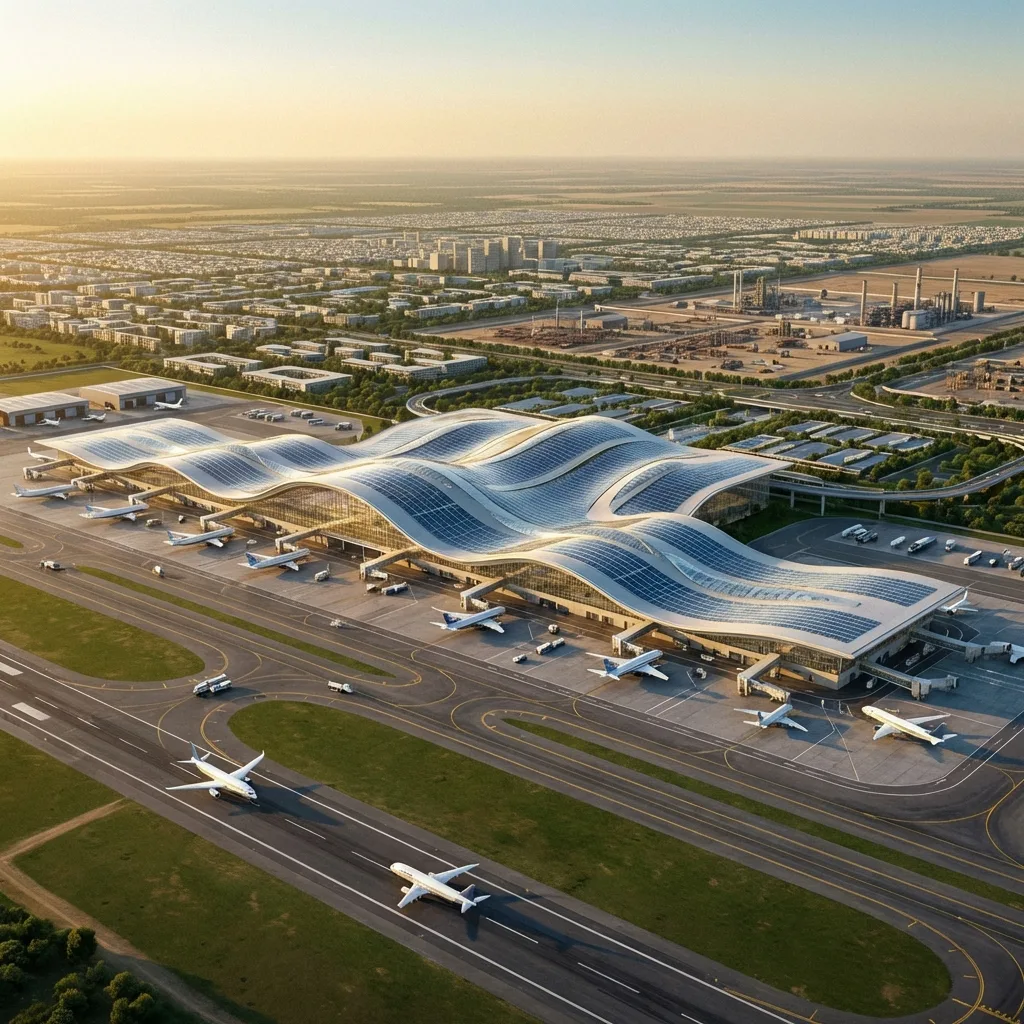
The Noida International Airport at Jewar is the single most significant infrastructure project in North India. Spanning over 5,000 hectares, this is not just an airport; it is the catalyst for the region‘s transition into a global Aerotropolis. As Phase 1 nears its 2026 operational target, the "Jewar Effect" is fundamentally redefining the real estate landscape of the National Capital Region. We are witnessing the birth of a Global Gateway that will rival the world‘s largest aviation hubs, creating a new epoch in Indian connectivity.
The Aerotropolis Concept: Living in the Heart of Motion
Traditional urban planning treated airports as secondary. The Aerotropolis model reverses this—the airport becomes the urban core, around which industry, commerce, and residence are meticulously organized. Jewar represents the first true application of this model at scale in India. Projected to handle 70 million passengers annually by its final phase, alongside a massive 2-million-tonne cargo facility, it mirrors the success of global airport cities like Narita in Tokyo and Incheon in South Korea. The airport is the Gravity Well for international investment, pulling in capital and talent from across the planet.
For investors in Pranth developers‘ projects, this means being part of a $100 billion economic ecosystem. The airport attracts multinational headquarters and high-tech clusters, eliminating the "transit friction" that currently hampers productivity. You can be in a global boardroom in Dubai or London within hours of leaving your luxury residence in Greater Noida. We are building the Infrastructure of Ambition, where the distance between local living and global working is minimized to zero. We call this Hyper-Connected Habitation.
Technical Excellence: The Zurich Standards
Being developed by Zurich Airport International AG, Jewar Airport is built to Swiss standards of precision and sustainability. The airport utilizes a "Digital Twin" model for construction and operations, allowing for real-time monitoring of every system. From automated baggage handling to AI-powered gate allocation, every detail is engineered to minimize "Passenger Friction." The terminal design focuses on Passive Cooling and natural light, aiming for a Net-Zero carbon footprint. This commitment to the environment is why Jewar is attracting green-conscious global corporations. This is Precision Aviation Engineering at its finest.
Aerotropolis Design Principles: The 30-60-90 Rule
In the world of Aerotropolis planning, we follow the 30-60-90 Rule. This refers to the time in minutes it takes to reach the airport from various urban zones. Jewar is designed such that the "Primary Core" (where Pranth projects in Sector 1 and 4 are located) remains within a 30-minute high-speed link. This proximity is the "Golden Zone" for real estate appreciation. Global data suggests that property values in the 30-minute zone grow at a rate of 1.5x the rest of the metro area. We utilize Isochrone Mapping to ensure our projects are always in the high-yield radius. This is Strategic Spatial Planning.

Logistics Synergy: The Dholera-Jewar Connection
At Pranth, we see a unique synergy between our projects in Dholera SIR and the Jewar Airport region. These are the two ends of India‘s new "Economic Spine." Dholera provides the manufacturing muscle (Semiconductors, Solar), while Jewar provides the global aviation and logistics gateway. This corridor is where the "New India" is being built. A product manufactured in the high-tech, solar-powered zones of Dholera can be transported via the DFC and exported globally through Jewar in under 24 hours. This is the efficiency of a developed nation. We call this the Industrial Silk Road, a high-velocity artery that powers the nation‘s GDP.
Multi-Modal Connectivity: The Ribbon of Speed
Jewar is revolutionary because of its Multi-Modal Transit integration. It is not an island; it is a node connected by a high-speed ribbon of infrastructure:
- Rapid Rail (RRTS): Connecting the airport to the Delhi-Ghaziabad-Meerut corridor, bringing Central Delhi within a 50-minute reach.
- India‘s first Pod Taxi system: Linking the airport to the 1,000-acre Film City, creating a futuristic local transit network.
- Aqua Line Extension: Providing direct metro connectivity to the heart of Noida and Greater Noida hubs.
- Dedicated Freight Corridor (DFC): Making the airport a global hub for e-commerce and high-value manufacturing exports.
- Chola Railway Station: Enhancing the rail-cargo link for heavy industrial goods.
- National Highway 91 Upgrade: Expanding the arterial bandwidth for surface logistics.
Regional Economic Impact: The North India Growth Pole
The Jewar Airport functions as the Regional Growth Pole for North India. It is projected to contribute roughly 3% to the GDP of Uttar Pradesh by 2030. This massive economic engine creates a "Wealth Ripple" that extends into all sectors—hospitality, retail, and education. We are seeing the emergence of "Knowledge Cities" and "Med-Tech Hubs" that rely on the airport for global talent and supply chain speed. The airport is creating 1.5 Million new jobs in its first phase alone. This is Macro-Economic Catalysis.
For the resident of a Pranth development, this means having world-class opportunities at your doorstep. The airport isn‘t just for travel; it is a signal of the region‘s entry into the global league of Tier-1 cities. We are fostering a Knowledge Economy where proximity to global minds is the ultimate luxury. We call this The Intellectual Aerotropolis.
The Economic Ripple Effect: Infrastructure as Wealth
Infrastructure is the primary creator of wealth. Global players like Microsoft, HCL, and Samsung are establishing massive campuses in the Jewar influence zone. The Yamuna Expressway Industrial Development Authority (YEIDA) has allotted land for specialized clusters including a Toy Park, an Apparel Park, and a Medical Device Park. This influx of capital produces secondary demand for high-end residential and hospitality spaces. This is Demand-Driven Appreciation that is immune to traditional market fluctuations. It is Institutional-Grade Real Estate.
For an investor, entering the Jewar corridor today is akin to investing in Gurgaon in the early 2000s. The "Economic Floor" is rising, driven by actual industrial activity. Every dollar invested in airport infrastructure is projected to generate five dollars in regional economic activity. We are witnessing the Financial Transformation of the NCR, where land is being converted into a high-yield liquid asset. This is The Millionaire Multiplier.
Real Estate Liquidity: The Exit Strategy
One of the often-overlooked benefits of airport-proximate real estate is Liquidity. These properties are highly sought after by institutional buyers, pension funds, and international NRIs. If you decide to sell your asset in a Pranth project near Jewar, the market is global, not just local. This "Exitable Wealth" is the hallmark of a savvy long-term investment. Airport assets are considered "Hard Assets" with low volatility and high predictability, making them the perfect hedge against inflation. This is The Liquidity Premium.
Aerocity Vision: A 24/7 Global Hub
Adjacent to the runways will be the Jewar Aerocity—a 1,000-acre development featuring luxury hotels, office towers, and high-end retail. This Aerocity will function as a "Mini-City" that never sleeps, catering to the needs of the global business traveler. For Pranth residents, this means having the world‘s finest dining and entertainment options within a 15-minute drive. It is Cosmopolitanism at the Core. We utilize Smart Grid technology to ensure the Aerocity is the most efficient urban zone in India.
The Strategic Investor‘s Checklist
- Exponential Capital Appreciation: Land values within 30km of major global airports appreciate at 3x the market average.
- High Rental Yields: An executive workforce of over 100,000 will be required by 2030, creating a robust rental market.
- Global Standards: Backed by Zurich Airport International AG, ensuring transparency and architectural excellence.
- Diversification: A unique asset that grows independently of the traditional domestic real estate cycle.
- NRI Trust: Swiss-managed infrastructure provides the confidence required for global capital inflows.
- First-Mover Advantage: Securing assets before the 2026 commercial operations trigger a "Price Step-Up."
"Jewar is not just an airport; it is the economic engine that will drive North India for the next 50 years. We are building the residential legacy that will house the leaders of this engine. This is the Manifesto of Progress."
Environmental Stewardship: A New Sky Standard
Jewar Airport is designed with a Sustainability-First approach. From 100% LED lighting to extensive grey-water recycling and an on-site massive solar farm, it aims to be the cleanest airport in Asia. This aligns with Pranth Developers‘ commitment to green luxury. Investors in our projects are not just buying property; they are investing in a sustainable future. We use Life Cycle Assessment (LCA) to ensure our developments match the longevity of the airport. This is Responsible Growth.
Conclusion: Secure Your Piece of the Future
The window of opportunity to enter at pre-operational prices is narrowing. As the first commercial flight takes off in 2026, the market will shift from anticipatory to realized value. The time to secure a piece of this global gateway is now. Pranth Developers is proud to be your guide in this journey. Welcome to the Aerotropolis. Welcome to the future. Welcome to the Pranth Gateway. Your ascent starts here.
The Cargo-City of 2030: India‘s Export Engine
Jewar is not just about passengers. It is being built as the Lufthansa of India—a dedicated Multi-Modal Cargo Hub. With a capacity of 1 million tonnes of cargo initially, rising to 5 million tonnes, Jewar will become the "Central Logistics Brain" of the NCR. For the commercial investor, this means the demand for warehousing and fulfillment centers in the surrounding sectors will be infinite. We call this Logistics Density. Pranth is developing specialized "Aerotropolis High-Streets" that serve the 50,000+ logistics and technical professionals who will move to this region by 2030. This is The Commerce of Flow. We are integrating Automated Sorting Centers and Drone-Delivery Pads into our commercial designs, ensuring they are ready for the 24/7 world of global trade. This is Logistics 4.0.
MRO Synergy: The High-Skill Real Estate Catalyst
The established MRO (Maintenance, Repair, and Overhaul) zone at Jewar is a game-changer for the high-end residential market. Aviation technicians and engineers are high-income professionals who require premium living spaces. This creates a "Reciprocal Value Loop" where the airport creates high-skill jobs, and those jobs drive demand for high-end real estate like Pranth Aura. This is Human Capital Appreciation. We are designing our residential floor plates to include "Engineering Studios" for these professionals, recognizing that work-from-home is now part of the aviation management cycle. This is Professional-Grade Luxury. The MRO sector is expected to create over 10,000 high-skill jobs by 2028, providing a rock-solid foundation for rental yields. This is The Institutional Guarantee.
The Aerotropolis Micro-Climate: Designing for the Sky
Airports can affect local temperatures. Pranth Developers has utilized Micro-Climatic Simulation to ensure that our projects in the Jewar vicinity remain 4-5 degrees cooler than the surrounding urban heat island. We achieve this through "Wind-Tunnel" building orientations and high-albedo roof surfaces. We are building for the Atmospheric Comfort of our residents. We utilize Mist-Cooling Networks in our public plazas that are powered by recycled airport condensation. This is Hydrological Synergie. Your home is not just a building; it is a Climatic Refuge. This is the Architecture of Resilience.