
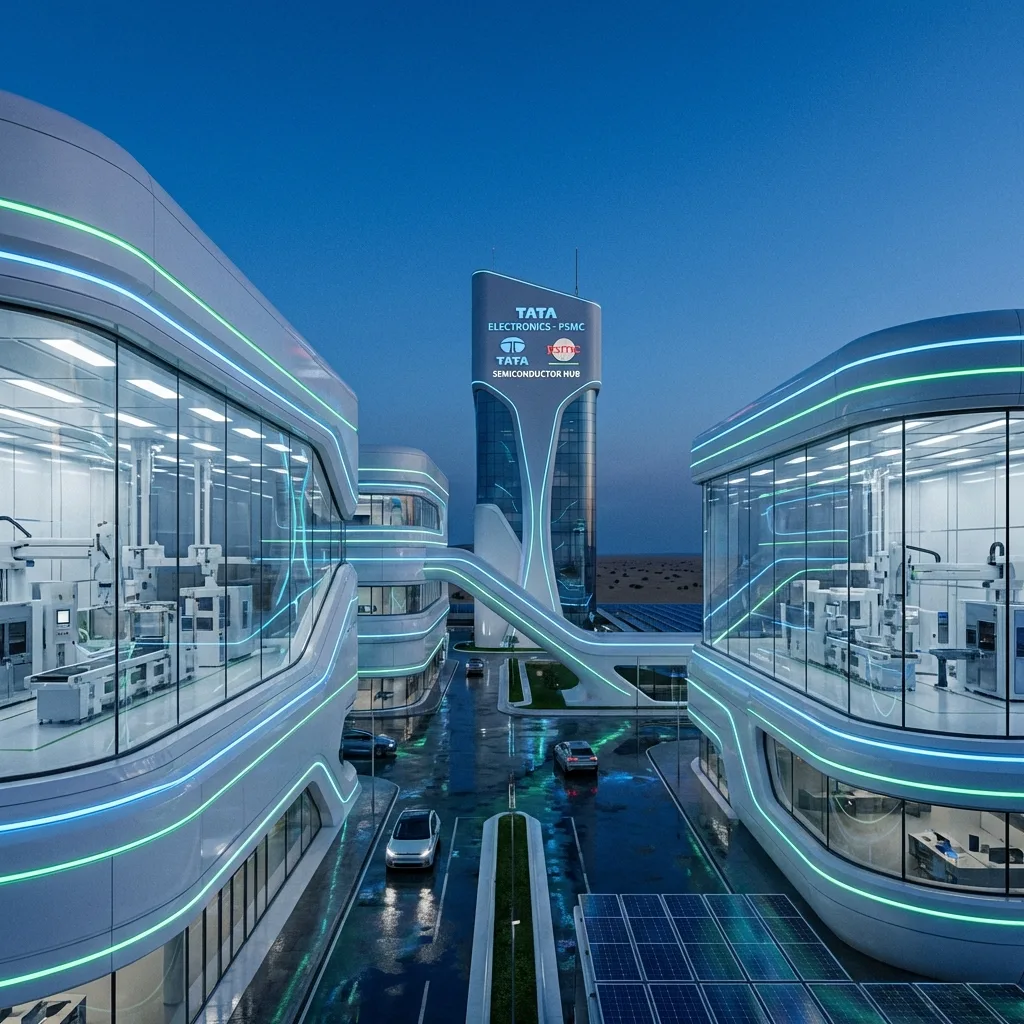
The silicon heart of India is beginning to beat in Dholera. With Tata Electronics breaking ground on the nation’s first commercial Semiconductor fab, Dholera has catapulted from a "Smart City project" to a Geo-Strategic Asset. We examine the timeline, the impact of the India Semiconductor Mission (ISM), and what this means for the region's economic DNA.
The global semiconductor shortage of 2020-2022 woke the world up to a harsh reality: dependence on a single supply chain (largely centered in East Asia) is a strategic vulnerability. India’s response was the India Semiconductor Mission (ISM), a $10 billion incentive program designed to lure chipmakers to the subcontinent. Dholera SIR has emerged as the unequivocal winner of this program, hosting India’s first commercial Fab.
The ₹91,000 Crore Game Changer
In partnership with Taiwan’s Powerchip Semiconductor Manufacturing Corporation (PSMC), Tata Electronics is establishing a mega-fab in Dholera with an investment exceeding ₹91,000 Crores ($11 Billion). This is not just a factory; it is an ecosystem anchor. A semiconductor fab, or "foundry," acts as a gravitational well. It is so complex and requires such specialized inputs that it pulls in hundreds of ancillary industries—chemical suppliers, gas providers, packaging units, and high-tech logistics firms—creating a massive industrial cluster.
This Fab will have a capacity of 50,000 wafers per month. To put that in perspective, this single facility will be capable of producing billions of chips annually, catering to industries ranging from automotive and power management to display drivers and microcontrollers. It places Dholera on the global technology map, right alongside Hsinchu (Taiwan) and Dresden (Germany).
Why Dholera? The Infrastructure Logic
Semiconductor manufacturing is notoriously resource-hungry. It requires ultra-stable power (a millisecond flicker, or "sag," can ruin millions of dollars of chips in production) and massive amounts of ultra-pure water. Dholera was chosen primarily for its robust utility grid, which was designed from the start to meet these exacting standards.
- Reliable Power: Torrent Power manages the distribution network in Dholera. The city’s grid is smart, redundant, and self-healing. We are talking about 99.999% uptime reliability, a non-negotiable requirement for the sensitive lithography machines used in chip making.
- Water Security: A fab consumes millions of liters of water daily. Dholera’s water infrastructure, fed by the Narmada canal and supplemented by massive desalination plants, ensures this thirst is quenched without stressing local groundwater tables. The city also features advanced wastewater treatment and recycling plants, aiming for a Zero Liquid Discharge (ZLD) status.
- Plug-and-Play Activation Area: Time is money in the tech world. The land in Dholera’s Activation Area was ready, zoned, and environmentally cleared. This allowed Tata to bypass years of potential bureaucratic hurdles and start construction almost immediately.
The 2026 Production Milestone
The timeline is aggressive. Construction is already underway, and by late 2026, the first "Made in India" chips are expected to roll off the Dholera production line. These will likely be 28nm chips—the workhorses of the modern world. While they are not the 3nm chips used in the latest iPhones, 28nm chips are essential for automobiles, appliances, IoT devices, and industrial machinery. This is the strategic sweet spot for India’s manufacturing sector.
This milestone will mark India’s entry into the elite club of semiconductor manufacturing nations, reducing import reliance on China and Taiwan and securing the nation's technological sovereignty. It transforms "Make in India" from an assembly slogan to a deep-tech reality.
Economic Ripple Effect: The "Tech-City" Transformation
For Dholera as a city, this changes the demographic projection entirely. Before the Fab, the expectation was mainly for heavy industrial workers and logistics personnel. Now, we are looking at thousands of highly skilled engineers, PHDs, expatriates from Taiwan and the West, and technical specialists moving to the city.
"The arrival of the Fab changes the real estate requirement from basic housing to premium lifestyle spaces. Engineers earning global salaries demand international schools, high-end retail, and luxury villas. This is the 'Silicon Valley' effect."
This demographic shift is already impacting land prices. We are seeing a surge in inquiries for "lifestyle" plots and premium residential zones. The need for 5-star hotels, convention centers, and high-end recreation is suddenly immediate. Investors holding residential and commercial land in Dholera are sitting on gold. The demand for rental yields from this incoming high-net-worth workforce is expected to outpace supply for the next decade.
The semiconductor revolution is here, and Dholera is its ground zero. Investing in Dholera today is akin to investing in Bangalore in the 1990s or Silicon Valley in the 1970s. The trajectory is exponential.